


Google Performance Max Negative Keyword Impact Prediction: Everything You Need to Know
Google has introduced Negative Keyword Impact Prediction for Performance Max campaigns. The feature estimates how proposed negative keywords could affect conversions or conversion value. Advertisers can preview the impact of up to 10 negative keywords before applying them. This helps reduce the risk of excluding valuable Search and Shopping traffic. ShoppingIQ explains how the feature works, its limitations and how advertisers should use it effectively.
13 Aug, 2026
Google has introduced Negative Keyword Impact Prediction for Performance Max campaigns, allowing advertisers to estimate how proposed negative keywords could affect conversions or conversion value before applying them.
This is an important development for Performance Max.
Google has gradually introduced more advertiser controls into PMax, including campaign-level negative keywords. However, greater control also creates greater risk: excluding the wrong search terms can unintentionally block valuable traffic and conversions.
This continues a wider shift towards more advertiser control in Performance Max. For another recent example, see our guide to Performance Max household income exclusions.
Negative Keyword Impact Prediction is designed to provide an additional layer of insight before advertisers make those decisions.
Here's everything you need to know.
What is Negative Keyword Impact Prediction?
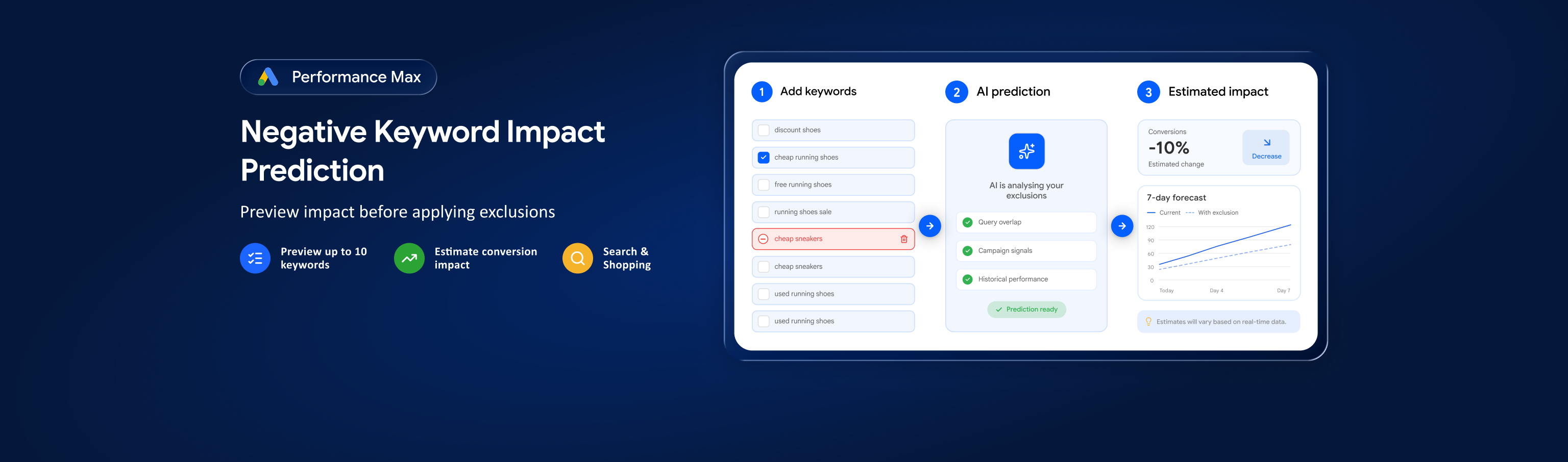
Negative Keyword Impact Prediction allows advertisers to preview the potential performance impact of adding negative keywords to a Performance Max campaign.
Instead of simply adding a negative keyword and monitoring what happens afterwards, advertisers can now ask Google to estimate the impact beforehand.
For example, Google may indicate that a proposed negative keyword could result in an estimated:
-10% impact on conversions
If the campaign historically generated 100 conversions during the relevant period, this suggests that excluding the term could potentially reduce conversion volume.
For campaigns optimising towards conversion value, the prediction may instead relate to the potential impact on conversion value.
The prediction is intended to help advertisers identify exclusions that could unintentionally remove valuable traffic.
Why has Google introduced this?
Performance Max has historically given advertisers less direct control over search targeting than traditional Search or Shopping campaigns.
Over time, Google has responded by introducing additional controls and reporting capabilities.
Campaign-level negative keywords were an important part of that development.
But they also created a new challenge.
An advertiser may identify a search term that appears irrelevant and exclude it, without realising that Google's historical data associates that traffic with valuable conversions.
Negative Keyword Impact Prediction adds a safeguard to that process.
Instead of:
Identify Search Term → Add Negative → Discover Impact Later
advertisers can now follow:
Identify Search Term → Propose Negative → Preview Impact → Review → Decide → Apply
This creates a much more informed optimisation workflow.
How Does Performance Max Negative Keyword Impact Prediction Work?
Within the negative keyword workflow in Google Ads, advertisers can enter the keywords they're considering excluding and select Preview impact.
Google then uses campaign data and its predictive models to estimate the potential performance effect of those exclusions.
Advertisers can preview the impact of up to 10 negative keywords at a time.
The result is shown as an estimated percentage impact based on the campaign's optimisation objective.
Importantly, previewing the impact does not automatically apply the negative keywords.
The advertiser still makes the final decision.
What Metrics Can Google Predict in Performance Max?
The prediction depends on the campaign's bidding and optimisation objective.
For campaigns focused on conversions, Google may estimate the potential impact on:
Conversions
For campaigns focused on value, the prediction may instead relate to:
Conversion Value
This helps make the forecast more relevant to the campaign's actual optimisation goal.
Where Is Performance Max Negative Keyword Impact Prediction Available?
At present, Google states that Negative Keyword Impact Prediction is available for:
Performance Max campaigns
The prediction relates to the inventory where Performance Max negative keywords apply:
-
Search
-
Shopping
Retailers working across Shopping inventory may also find our guide to Google Shopping Ads feed management useful.
Google has indicated that similar prediction capabilities could potentially expand to additional campaign types or targeting controls in the future.
What are the current limitations?
There are several important limitations advertisers should understand.
Performance Max only
The feature is currently designed specifically for Performance Max campaigns.
Maximum 10 keywords per preview
Advertisers can preview up to 10 negative keywords at once.
Larger negative keyword lists will therefore need to be assessed in batches.
Predictions are estimates
Google's prediction is based on historical campaign data and modelling.
It is not a guarantee of future performance.
Actual results can differ because of:
-
Seasonality
-
Competitor activity
-
Changes in search behaviour
-
Budget changes
-
Bidding adjustments
-
Product availability
-
Promotional activity
-
Changes in conversion rates
The forecast should therefore be treated as another optimisation signal rather than an absolute answer.
Why Is Negative Keyword Impact Prediction Useful?
Negative keywords can be extremely valuable in Performance Max.
They can help prevent campaigns from appearing for:
-
Irrelevant searches
-
Unwanted informational queries
-
Job-related searches
-
Competitor terms where appropriate
-
Products or services the advertiser doesn't offer
-
Low-value traffic
-
Searches that conflict with the advertiser's business model
However, aggressive negative keyword strategies can also restrict Google's ability to find conversions.
Impact Prediction helps advertisers understand that potential trade-off before making the exclusion.
Example: When Google's warning could be useful
Imagine a premium footwear retailer notices searches containing:
"cheap running shoes"
The immediate reaction might be to exclude "cheap" because it doesn't appear aligned with the brand's premium positioning.
However, Google may predict that excluding the term could materially reduce conversions.
That should prompt further investigation.
Perhaps users searching for cheaper products are still purchasing discounted premium shoes.
Or Google's broader matching has identified valuable purchasing behaviour associated with those searches.
Instead of immediately applying the negative keyword, the advertiser can now investigate the data first.
But should you always follow Google's prediction?
No. This is one of the most important points about the update.
Google's prediction tells advertisers what its system believes could happen to performance.
It doesn't understand every commercial consideration behind the advertiser's strategy.
For example, imagine a business sells only new premium furniture, but Performance Max is appearing against searches involving:
-
Used furniture
-
Free furniture
-
Furniture repair
-
Furniture jobs
Google could theoretically predict some loss in conversions from excluding certain traffic.
But those searches may still be fundamentally inappropriate for the business.
Advertisers therefore need to combine Google's prediction with their understanding of:
-
Business objectives
-
Profitability
-
Product positioning
-
Customer quality
-
Search intent
-
Lifetime value
-
Brand strategy
The prediction should inform the decision, not make the decision.
A Better Negative Keyword Workflow for Performance Max
Rather than adding negative keywords purely because a search term looks undesirable, advertisers can now follow a more structured process:
1. Analyse Search Terms
Identify potentially irrelevant, inefficient or commercially unsuitable searches.
2. Check Business Relevance
Ask whether the search genuinely conflicts with the advertiser's products, services or objectives.
3. Review Performance
Check conversions, conversion value, CPA and ROAS where sufficient data exists.
4. Preview the Negative Keyword Impact
Use Google's prediction to understand the potential consequences of the exclusion.
5. Make the Decision
Combine Google's forecast with campaign performance and business context.
6. Monitor After Implementation
Continue monitoring performance after adding the negative keyword.
Prediction does not replace post-change analysis.
What Does This Tell Us About Performance Max?
This update is interesting beyond the feature itself.
Performance Max originally operated with relatively limited advertiser control.
Google has gradually moved towards a different model:
Automation + Advertiser Controls + Predictive Guidance
Advertisers are receiving more ability to influence how Performance Max operates, while Google simultaneously introduces tools designed to explain or predict the consequences of those decisions.
Negative Keyword Impact Prediction is a good example.
For another recent Performance Max development, see our guide to the Local Services Ads Performance Max migration.
Google isn't removing advertiser control.
Instead, it's effectively saying:
"You can make this exclusion, but here's what our system thinks could happen if you do."
That could be an indication of how Google intends to balance AI-driven optimisation with increasing advertiser control going forward.
What Should Advertisers Do?
We recommend using Negative Keyword Impact Prediction whenever significant Performance Max exclusions are being considered.
However, avoid creating arbitrary rules based purely on Google's predicted percentage.
Instead, consider:
Business relevance → Historical performance → Predicted impact → Human judgement
Advertisers should also be particularly careful with:
-
High-volume keywords
-
Broad negatives
-
Brand-related terms
-
Generic category searches
-
High-converting search themes
These exclusions can potentially have much wider consequences than highly specific irrelevant searches.
What Does This Mean for Agencies?
For agencies managing multiple Performance Max campaigns, this feature provides an additional quality-control layer.
It can help teams:
-
Validate negative keyword recommendations
-
Reduce accidental over-exclusion
-
Explain optimisation decisions to clients
-
Identify potentially valuable search traffic
-
Make PMax optimisation more data-driven
-
Add another review step before significant campaign changes
It could also be useful during account audits where large negative keyword strategies are being proposed.
Key Takeaways
|
Topic |
Update |
|
Feature |
Negative Keyword Impact Prediction |
|
Campaign type |
Performance Max |
|
Purpose |
Estimate potential impact before adding negative keywords |
|
Inventory affected |
Search & Shopping |
|
Preview limit |
Up to 10 negative keywords at once |
|
Prediction |
Potential % impact on conversions or conversion value |
|
Automatically apply negatives? |
No |
|
Is the prediction guaranteed? |
No |
|
Recommended approach |
Combine prediction with performance data and business relevance |
ShoppingIQ Recommendation
Negative Keyword Impact Prediction is a welcome addition to Performance Max.
Negative keywords remain an important optimisation tool, but they should never be applied simply because a search term looks undesirable at first glance.
Our recommended decision framework is:
Relevance First → Performance Data → Google's Prediction → Human Decision
Google's forecast provides useful additional information, but advertisers still need to understand the business behind the campaign.
The best optimisation decisions will continue to combine Google's machine learning with experienced human judgement.
Final Thoughts
For years, the conversation around Performance Max has focused on advertisers wanting more control.
Google is increasingly providing that control.
But Negative Keyword Impact Prediction introduces an interesting next phase.
Google isn't simply giving advertisers more buttons to press. It's beginning to provide predictive guidance around what could happen when those controls are used.
That could represent an important evolution in Performance Max:
From black-box automation → to advertiser control supported by Google's AI predictions.
And that may ultimately be more valuable than simply adding more manual settings.
Frequently Asked Questions
What is Negative Keyword Impact Prediction in Performance Max?
Negative Keyword Impact Prediction is a Google Ads feature that estimates how adding specific negative keywords to a Performance Max campaign could affect conversions or conversion value before those keywords are applied.
How many negative keywords can you preview at once?
Advertisers can preview the predicted impact of up to 10 negative keywords at a time. Larger lists need to be reviewed in batches.
Does Preview Impact automatically apply negative keywords?
No. Previewing the impact does not automatically add the negative keywords. The advertiser reviews the prediction and makes the final decision.
Which Performance Max inventory does the prediction apply to?
Negative Keyword Impact Prediction applies to Search and Shopping inventory, which are the same inventories where Performance Max negative keywords apply.
Is Google's predicted impact guaranteed?
No. The prediction is an estimate based on historical campaign data and modelling. Actual performance can vary because of factors such as seasonality, competition, budget, bidding, product availability and conversion-rate changes.