



Household Income Exclusions Coming to Performance Max? What Google Ads Advertisers Need to Know
Google appears to be testing household income exclusions for Performance Max campaigns, giving advertisers more control over audience targeting. Learn which income segments may be excluded, who could benefit, and what advertisers should consider before using this new optimisation feature.
31 Jul, 2026
Google appears to be testing one of the most requested Performance Max audience control features: the ability to exclude users based on household income.
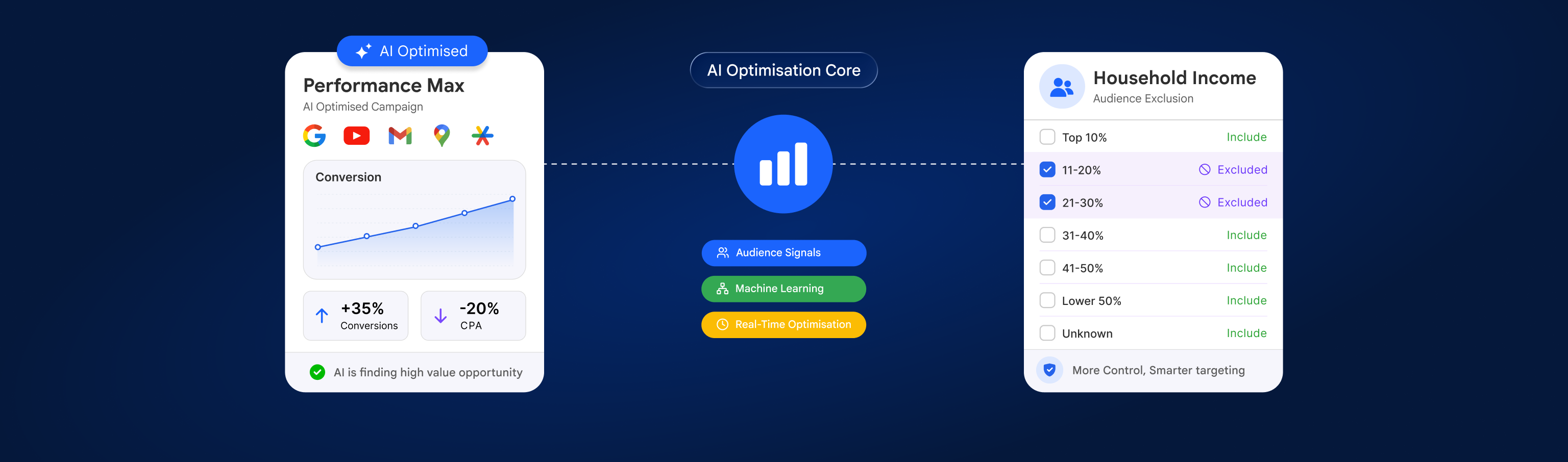
While Google has not yet officially announced the update, advertisers have started spotting a new campaign setting that allows specific household income brackets to be excluded directly within Performance Max campaigns.
If this rollout expands globally, it would represent one of the biggest improvements to Performance Max targeting controls since the campaign type launched.
Here is everything we know so far about Google Ads household income exclusions and what advertisers should consider.
What's Changing in Performance Max?
Until now, advertisers using Performance Max have had very limited demographic exclusion options.
Although Google has gradually introduced controls such as:
-
Campaign-level negative keywords
-
Brand exclusions
-
Device targeting
-
Age exclusions
-
Gender exclusions
-
Customer list exclusions
...household income exclusions have remained unavailable in Performance Max.
That now appears to be changing.
A new campaign setting has been spotted allowing advertisers to exclude users based on Google's estimated household income segments.
Which Household Income Segments Can Be Excluded?
The reported options mirror those already available in Search, Display, Demand Gen and Video campaigns:
-
Top 10%
-
11–20%
-
21–30%
-
31–40%
-
41–50%
-
Lower 50%
-
Unknown Household Income
Advertisers can simply select the income brackets they wish to exclude from their Performance Max campaign targeting.
Why Are Household Income Exclusions Important for Performance Max?
Since Performance Max launched, one of the biggest criticisms has been the limited level of advertiser control.
Google has steadily responded by introducing additional controls over the last two years, giving advertisers more influence while keeping automation at the centre of campaign optimisation.
This latest addition provides another important lever without removing Google's AI-driven bidding and targeting capabilities.
Rather than telling Google exactly who to target, advertisers can now provide additional signals about who not to target based on estimated household income.
For advertisers already focused on improving campaign profitability, these additional controls work alongside other optimisation strategies, such as Google's Maximise Conversion Value bidding approach in Standard Shopping campaigns. You can learn more about this update in our guide on Maximise Conversion Value Now Available in Standard Shopping.
Which Advertisers Could Benefit From Performance Max Income Exclusions?
This feature could be particularly valuable for businesses where purchasing power strongly influences buying behaviour.
Luxury Retail
-
Premium fashion
-
Luxury watches
-
Designer furniture
-
High-end jewellery
-
Luxury travel
Automotive
-
Premium vehicle manufacturers
-
Luxury dealerships
-
Electric vehicle brands
Financial Services
-
Private banking
-
Wealth management
-
Investment services
-
Premium insurance
Home Improvement
-
Luxury kitchens
-
Premium home renovations
-
Swimming pools
-
High-end interiors
Value-Focused Retailers
Interestingly, the opposite approach can also apply.
Discount retailers may choose to exclude higher-income segments if their products primarily appeal to price-conscious consumers.
Why Has Household Income Targeting Been Difficult in Performance Max?
Performance Max is designed to allow Google's AI to identify the best audiences based on conversion signals.
Unlike traditional campaign types, advertisers have historically had fewer ways to restrict targeting.
This has created challenges for businesses selling products aimed at a specific socioeconomic audience.
Household income exclusions could help address this gap while still allowing Google's machine learning to optimise within the remaining eligible audience.
Is Google Household Income Data Accurate?
It is important to remember that household income is an estimated signal, not declared information.
Google uses aggregated and inferred data to place users into household income brackets. As a result:
-
Not every user can be classified.
-
Some users will appear as Unknown Household Income.
-
Availability is limited to supported countries.
Google has supported household income targeting in Search, Display, Demand Gen and Video campaigns for several years using these estimated audience segments.
Which Countries Support Household Income Targeting?
Household income targeting is not available worldwide.
Google currently supports these demographic signals in selected markets, including:
-
United States
-
Canada
-
Australia
-
India
-
Singapore
-
Japan
-
South Korea
-
United Arab Emirates
-
Brazil
-
Mexico
Along with several additional supported countries.
Has Google Officially Confirmed Performance Max Household Income Exclusions?
Not yet.
At the time of writing:
-
Google has not published an official announcement.
-
The feature has been spotted in a limited number of advertiser accounts.
-
It appears to be part of a gradual rollout or test.
As with many Google Ads updates, new controls often appear in selected accounts before being formally announced.
What Should Advertisers Do?
If the feature becomes available in your account:
-
Review whether household income is genuinely a buying signal for your products.
-
Avoid excluding large audience groups without supporting performance data.
-
Test gradually and monitor conversion volume, CPA and ROAS.
-
Ensure Google has enough conversion data to optimise effectively.
For many advertisers, broad targeting will continue to perform best.
Income exclusions should be used strategically, not as a default campaign setting.
ShoppingIQ Recommendation
This update appears to be another example of Google gradually adding more advertiser controls to Performance Max without reducing automation.
For businesses targeting premium or value-specific audiences, household income exclusions could become a useful optimisation tool.
However, because the feature is still in limited rollout and household income is an inferred signal, advertisers should treat this as a testing opportunity rather than an immediate best practice.
Strong campaign performance still depends on accurate product data, effective feed management and high-quality conversion signals. Learn more about building stronger Shopping campaigns with our guide to Google Shopping Ads.
As always, audience exclusions should be driven by business objectives and performance data, not assumptions.
Key Takeaways
|
Topic |
Update |
|
Feature |
Household Income Exclusions in Performance Max |
|
Status |
Limited rollout / Not officially announced |
|
Applies to |
Performance Max campaigns |
|
Available segments |
Top 10%, 11–20%, 21–30%, 31–40%, 41–50%, Lower 50%, Unknown |
|
Best suited for |
Luxury, automotive, financial services, premium retail and value-focused brands |
|
Recommendation |
Test carefully once available in your account |
Final Thoughts
Performance Max has gradually evolved from a highly automated campaign type with limited controls into a platform that gives advertisers greater influence over how Google's AI operates.
If household income exclusions roll out globally, they could become another valuable optimisation tool, particularly for advertisers whose products appeal to specific income groups.
However, automation still works best when combined with strong data signals. Before excluding any audience, advertisers should ensure decisions are supported by performance insights rather than assumptions.
We will continue monitoring this rollout and share further updates if Google confirms wider availability or publishes official documentation.