



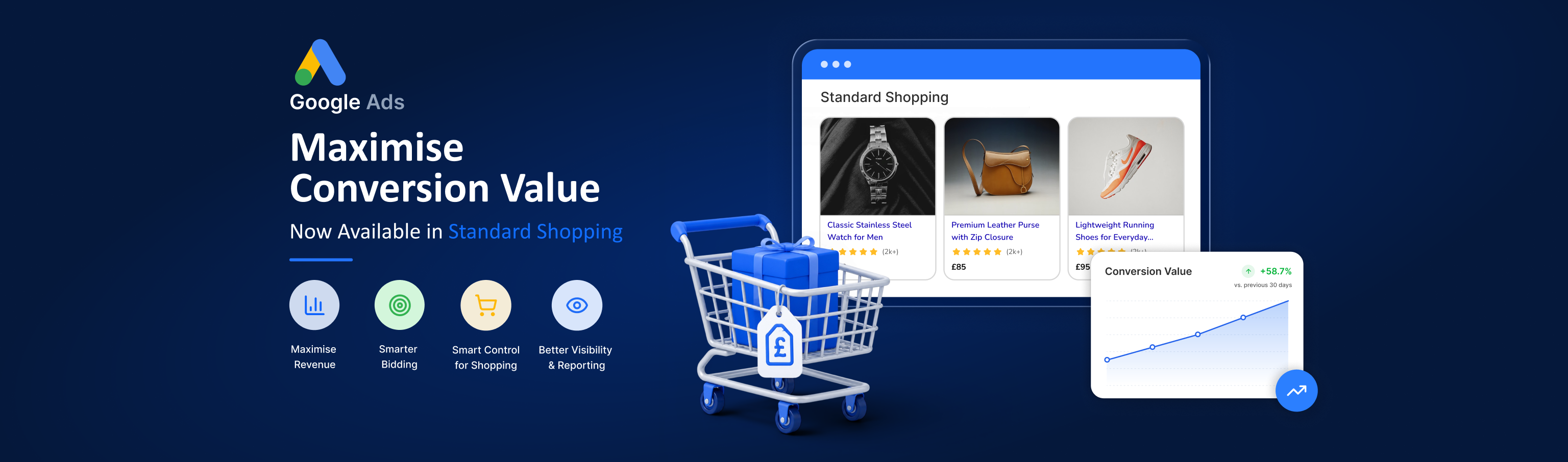
Maximise Conversion Value Now Available in Standard Shopping: What Ecommerce Advertisers Need to Know
Google has introduced Maximise Conversion Value Standard Shopping, bringing value-based Standard Shopping Smart Bidding to Standard Shopping campaigns without requiring migration to Performance Max. This update allows ecommerce advertisers to optimise for revenue rather than just conversions while retaining control, transparency, and reporting advantages of Standard Shopping. It is most effective for accounts with strong conversion tracking and sufficient historical data.
29 Jun, 2026
Google has quietly introduced an important update for advertisers running Standard Shopping campaigns.
Maximise Conversion Value Standard Shopping bidding is now available, giving retailers access to Google's value-based Standard Shopping Smart Bidding without needing to migrate to Performance Max.
While the update may appear small, it represents another step towards bringing more advanced AI-driven Standard Shopping Smart Bidding capabilities to advertisers who still prefer the control and transparency of Standard Shopping.
What is Maximise Conversion Value?
Unlike Maximise Conversions, which focuses on generating as many conversions as possible, Maximise Conversion Value Standard Shopping is designed to maximise the total conversion value generated from your available budget.
For example, if your store sells products ranging from £20 accessories to £1,000 appliances, Google's Standard Shopping Smart Bidding system can prioritise users more likely to purchase higher-value products, increasing overall revenue rather than simply increasing order volume.
The strategy uses Google's auction-time Standard Shopping Smart Bidding to analyse hundreds of signals including:
-
Search intent
-
Device
-
Location
-
Time of day
-
Audience signals
-
Historical conversion values
-
Product performance
-
User behaviour
Each auction receives its own optimised bid in real time.
Why is this significant?
Previously, many advertisers associated value-based Standard Shopping Smart Bidding primarily with Performance Max.
Now, Maximise Conversion Value Standard Shopping allows advertisers to benefit from the same optimisation approach while maintaining the advantages that Standard Shopping offers, including:
-
Greater campaign control
-
Product-level visibility
-
Detailed search term reporting
-
Flexible campaign structures
-
Easier use of negative keywords
For businesses that prefer managing Shopping campaigns manually while still benefiting from Google's AI bidding, this is a welcome addition.
If you're planning to test new bidding strategies, it's also worth reviewing our guide on Google Ads campaign experiments.
When should you use it?
This bidding strategy is best suited for retailers that:
-
Pass dynamic purchase values into Google Ads
-
Have reliable conversion tracking
-
Generate consistent conversion volume
-
Sell products with varying price points
Accounts with mature Shopping campaigns and sufficient historical data are likely to see the strongest results with Maximise Conversion Value Standard Shopping.
When may it not be the best choice?
Maximise Conversion Value Standard Shopping may be less suitable if:
-
Conversion tracking is incomplete or inaccurate
-
Purchase values are not being passed correctly
-
The account has very limited conversion volume
-
Every conversion is worth roughly the same amount
In these cases, alternative bidding strategies such as Maximise Conversions or Target CPA may remain more appropriate.
What about Target ROAS?
Many advertisers will start by using Maximise Conversion Value Standard Shopping before introducing a Target ROAS once enough conversion value data has been collected.
This allows Google's Standard Shopping Smart Bidding algorithm to first understand purchasing behaviour before optimising towards a specific return on ad spend objective.
If you're actively managing campaign budgets, you may also find our article on Google's Daily Budget Pacing Update helpful.
Our Thoughts
This update continues Google's gradual enhancement of Standard Shopping rather than limiting advanced bidding features to Performance Max.
For ecommerce advertisers that value transparency and campaign control, Maximise Conversion Value Standard Shopping offers an excellent opportunity to combine AI-powered Standard Shopping Smart Bidding with the flexibility of Standard Shopping.
As always, the key to success lies in accurate conversion tracking, high-quality product feeds, and allowing sufficient time for Standard Shopping Smart Bidding to learn. Google's own documentation on Smart Bidding best practices provides additional guidance.
For retailers already running mature Standard Shopping campaigns, Maximise Conversion Value Standard Shopping is certainly a feature worth testing as part of your optimisation strategy.