


Google Ads Rolls Out AI Content Labels: What Advertisers Need to Know
Google is introducing AI content labels across Google Ads, Merchant Center and other advertising platforms. The update helps identify certain images and videos created or edited using AI. Advertisers using AI-generated creative should now consider how assets are produced, where they are used and whether disclosure is required.
21 Aug, 2026
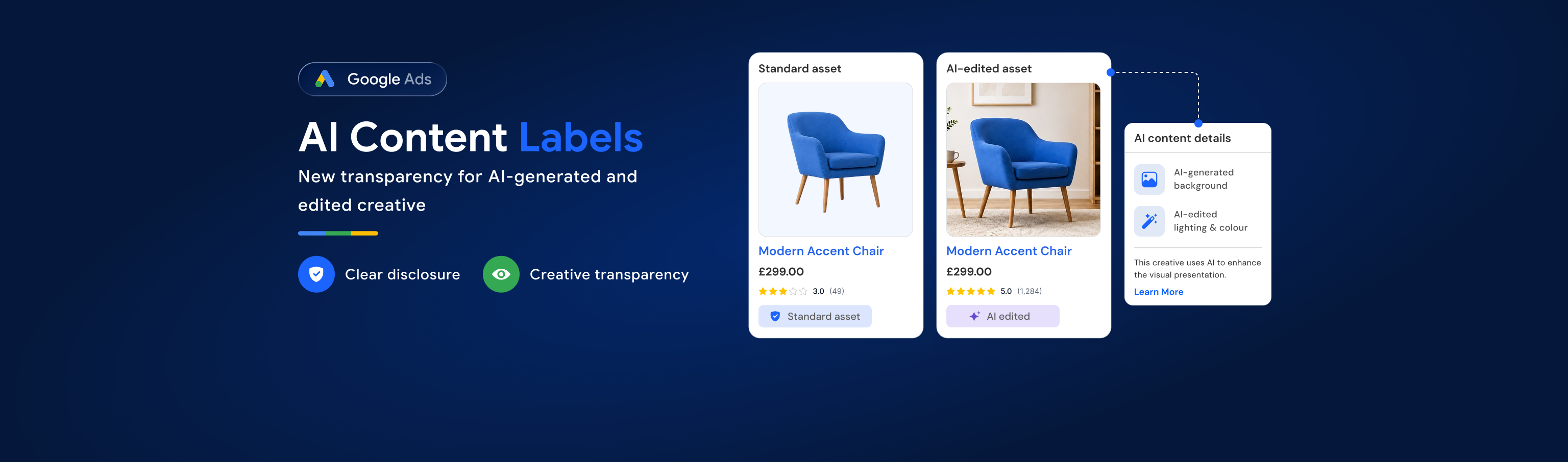
Google is introducing new AI content labelling capabilities across its advertising ecosystem, giving advertisers tools to identify certain image and video assets that have been created or edited using artificial intelligence.
The AI label setting rolled out gradually during July across Google Ads, Merchant Center, Display & Video 360, Campaign Manager 360 and Google Ads Editor. The move supports growing AI transparency requirements, including requirements Google highlights in the European Union, India and New York.
For advertisers and retailers increasingly using AI-generated creative, this introduces an important new consideration:
It’s no longer only about how AI content is created. Advertisers also need to think about how its use is disclosed.
What's Changing With Google Ads AI Content Labels?
Google's new AI label setting enables applicable image and video assets to be identified as created or edited using AI.
This isn't limited to content generated through Google's own AI tools. Advertisers importing externally created AI assets also need to consider whether disclosure is required.
For consumers, Google is also expanding the “How this ad was made” section within My Ad Center. On Search, YouTube and Discover, users can access information about how an ad was created through the ad's menu.
Will AI Labels Actually Appear on Ads?
Potentially, yes.
There are two levels of transparency to understand.
Globally, information about AI use can be made available through Google's “How this ad was made” experience.
For campaigns targeting certain regulated locations, including the EU, India and New York, applicable AI-generated or edited assets may require disclosures and/or labels informing consumers that AI was used.
So advertisers shouldn't assume that AI disclosure will always be hidden within an information menu. Depending on the campaign and applicable requirements, the disclosure may be more visible.
What About Creative Generated Using Google's AI?
In some circumstances, Google can handle AI labelling automatically.
Google's guidance explains that it may apply labels where it has a legal obligation, receives relevant information from another platform, or where certain fully automated Google features create and serve the creative.
Where Google applies the designation itself, advertisers may not necessarily be able to override it.
This means AI disclosure isn't entirely dependent on advertisers manually identifying every asset.
What About AI Creative Produced Outside Google?
This is particularly important for agencies.
AI-generated advertising assets are increasingly being created through external platforms before being uploaded into Google Ads or Merchant Center.
For example:
Original Product Image → AI Lifestyle Environment → Google Ads / Merchant Center
The fact that Google didn't generate the image doesn't automatically remove the advertiser's disclosure responsibilities.
Advertisers therefore need to understand how their creative was produced, not simply where it was uploaded.
Why Shopping Advertisers Should Pay Attention
One of the most important aspects of this update for ecommerce businesses is that Google's AI label setting also extends to Merchant Center.
Retailers are increasingly using AI for:
-
Lifestyle product imagery
-
Background replacement
-
Product staging
-
Seasonal creative
-
Image enhancements
-
Additional product images
That means creative provenance is becoming relevant to the Shopping feed workflow too.
Previously, teams might primarily ask:
Does this image meet Google's image requirements?
Increasingly, there may be a second question:
How was this image created, and does the use of AI need to be disclosed?
This is especially important for retailers scaling AI-generated lifestyle imagery across large product catalogues.
As Google continues adding more AI-led advertising features, retailers should also monitor changes such as the Google Ads Budget Panel for Performance Max and how these developments affect campaign management.
Does Every Use of AI Require a Label?
Not necessarily.
Google's guidance refers to certain AI-generated or edited assets, and disclosure requirements can depend on the nature of the content, how it was created and where the campaign is targeting.
Advertisers therefore shouldn't assume that every minor interaction with an AI-powered editing tool creates exactly the same disclosure obligation.
Equally, they shouldn't assume that externally generated AI creative is exempt.
Where there is uncertainty, advertisers should check Google's current guidance and any applicable local requirements.
Does Google's AI Label Guarantee Compliance?
No.
Using Google's AI label setting doesn't remove the advertiser's responsibility for complying with applicable laws and regulations.
Google is providing tools to support transparency, but advertisers remain responsible for understanding the requirements that apply to their campaigns.
This distinction is particularly important for agencies operating campaigns across multiple countries.
What Should Advertisers Do Now?
There is no reason to stop using AI creatively. Instead, advertisers and agencies should introduce a simple AI creative review process:
1. Identify – Understand whether an asset was original, traditionally edited, AI-assisted or AI-generated.
2. Record – Know whether the creative came from the client, agency, Google AI or an external AI platform.
3. Review – Check whether the AI use requires disclosure based on the asset and target market.
4. Disclose – Use Google's AI labelling tools where appropriate and retain clear records of significant AI-generated creativity.
For agencies, this may mean adding one simple question to the creative approval process:
“Was AI used to create or materially edit this asset?”
Key Takeaways
|
Topic |
What You Need to Know |
|
Update |
Google AI content labelling |
|
Content |
Certain AI-generated or AI-edited images and videos |
|
Platforms |
Google Ads, Merchant Center, DV360, CM360 & Ads Editor |
|
Consumer transparency |
“How this ad was made” |
|
Markets highlighted by Google |
EU, India & New York |
|
Google AI assets |
Google may handle some labelling automatically |
|
External AI assets |
Advertisers need to consider disclosure requirements |
|
Merchant Center |
Included in the rollout |
|
Legal compliance |
Advertiser responsibility remains |
ShoppingIQ Recommendation
The most important takeaway isn't simply that Google has introduced another label.
It's that AI transparency now needs to become part of the advertising workflow.
For retailers and agencies using AI-generated creative, we recommend thinking in terms of:
Create → Identify → Review → Disclose → Advertise
AI can dramatically improve the speed and scale of creative production. But as adoption increases, advertisers also need visibility over where AI has been used and whether that use needs to be disclosed.
AI-driven advertising is also developing beyond Google, with platforms such as OpenAI expanding advertising capabilities through developments like ChatGPT Ads self-serve buying and CPC bidding.
For Shopping advertisers in particular, now is a good time to start recording the origin of significant AI-generated or AI-edited product and lifestyle imagery supplied to Merchant Center.
Want to improve your Google Shopping performance? Explore ShoppingIQ's Google Shopping Ads services to improve feed quality, Merchant Center management and campaign performance.
Final Thoughts
For the past few years, much of the advertising conversation has focused on:
“How can we use more AI?”
The next question is becoming:
“When we use AI, will consumers know?”
Google is no longer building only the infrastructure for AI creation and optimisation. It's also building the infrastructure for AI identification and transparency.
For advertisers, that doesn't mean stepping away from AI.
It means using it more responsibly:
Use AI. Understand where you're using it. Keep track of it. And disclose it appropriately when required.