


OpenAI Expands ChatGPT Ads with Self-Serve Buying and CPC Bidding
OpenAI’s expansion of ChatGPT advertising marks a major step towards mainstream AI-powered marketing, introducing self-serve campaign management, CPC bidding, and advanced conversion tracking. These developments make conversational advertising more accessible to businesses of all sizes while enabling performance-focused campaign optimisation. As AI-driven search and shopping continue to grow, brands that invest in structured product data and conversational optimisation will be better positioned to capture high-intent consumers and drive future growth.
15 May, 2026
OpenAI’s expansion of ChatGPT advertising is signalling a major shift in how brands may reach consumers through conversational AI. After an initial rollout limited to select advertisers, the platform is now moving towards broader adoption with the introduction of self-serve campaign management, CPC bidding models, and more advanced conversion tracking capabilities.
ChatGPT Advertising Moves Towards Mainstream Adoption
In the early stages, advertising within ChatGPT was only available to a small number of enterprise-level brands. This restricted access naturally limited experimentation and prevented many growing businesses from participating.
That is now changing.
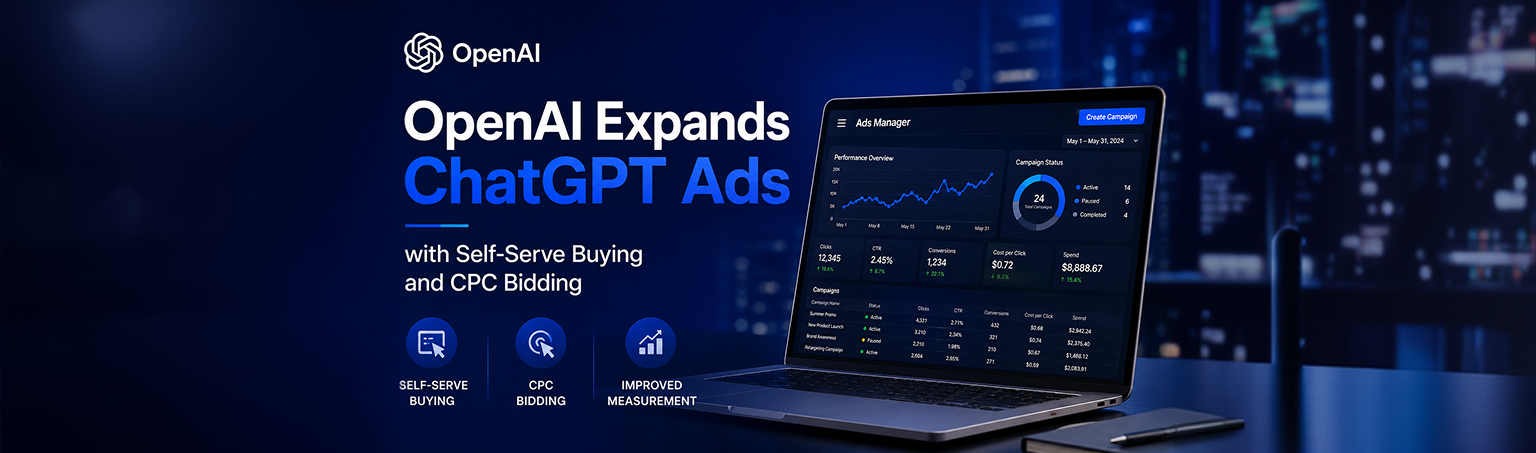
OpenAI has started introducing a beta Ads Manager platform, giving advertisers the ability to launch and manage campaigns directly. Instead of relying on managed access or intermediary support, businesses can now control campaign setup, budgets, bidding strategies, creative assets, and reporting themselves.
This move represents a significant transition from a tightly controlled testing environment to a scalable advertising ecosystem that could eventually become accessible to brands of all sizes, including startups and SMEs.
CPC Bidding Introduces Performance-Focused Advertising
One of the biggest developments is the move from CPM-based pricing to cost-per-click (CPC) bidding.
Previously, advertisers paid based on impressions. With CPC bidding, spend becomes tied directly to engagement, meaning businesses only pay when users actively click on ads.
This aligns ChatGPT more closely with established performance advertising channels such as Google Ads and Meta Ads, while also introducing unique advantages linked to conversational search behaviour.
Users interacting with AI assistants often display high intent. Queries are typically more exploratory, product-focused, and decision-oriented compared to traditional browsing. As a result, clicks within conversational experiences may indicate stronger commercial interest and potentially higher conversion value.
For retailers and brands preparing for AI-driven commerce, structured product feeds and conversational optimisation are becoming increasingly important. Businesses looking to improve visibility in AI shopping environments can explore ChatGPT Shopping Ads Feed Management to understand how feed quality, product data, and AI-ready optimisation may influence future performance.
Improved Attribution and Conversion Tracking
Measurement remains one of the most critical challenges for emerging ad platforms.
To improve advertiser visibility into campaign performance, OpenAI is introducing both pixel tracking and Conversions API integrations. These tools allow advertisers to monitor actions such as:
-
Purchases
-
Lead submissions
-
Sign-ups
-
Other conversion events
The addition of server-side tracking capabilities gives advertisers a stronger framework for optimisation and reporting, helping campaigns move beyond awareness metrics into measurable business outcomes.
At the same time, OpenAI is maintaining a strong privacy-first approach. Advertisers do not gain access to individual user conversations, with reporting designed around aggregated and anonymised data.
Expanding the Advertising Partner Ecosystem
OpenAI is also strengthening its advertising infrastructure through partnerships with established marketing and commerce platforms.
Integrations with companies such as Adobe, Criteo, and Pacvue are designed to help advertisers manage campaigns more efficiently across creative production, budgeting, optimisation, and reporting workflows.
While OpenAI still controls ad delivery within ChatGPT, these partnerships provide advertisers with familiar tools and operational efficiencies that can simplify campaign management at scale.
A Potential Opportunity for SMBs
The broader rollout of self-serve tools could have the biggest impact on small and medium-sized businesses.
Historically, emerging ad platforms have often favoured larger advertisers with dedicated budgets and account teams. By lowering entry barriers, OpenAI is opening the door for smaller businesses to experiment with conversational advertising and AI commerce experiences without requiring enterprise-level spend.
As adoption increases, competition within the platform is also likely to grow, encouraging more innovation in creative formats, targeting strategies, and conversational commerce experiences.
The Future of Advertising in Conversational AI
ChatGPT advertising is still in its early stages, but the direction is becoming increasingly clear.
Self-serve infrastructure, CPC bidding, improved attribution, and ecosystem partnerships are laying the foundation for a scalable AI advertising platform that could evolve rapidly over the next few years.
As conversational search and AI-assisted shopping continue to develop, advertisers will likely need to rethink how product data, feed optimisation, intent signals, and user engagement work together in environments where discovery happens through dialogue rather than traditional search results.
Conclusion
OpenAI's expansion of ChatGPT advertising is reshaping digital marketing by offering self-serve campaign management, CPC bidding, and improved conversion tracking. This shift opens up opportunities for small and medium-sized businesses to run high-performance campaigns without large budgets.
As the platform evolves, businesses will need to adapt to AI-driven commerce, focusing on structured product feeds and conversational optimisation. Early adoption of these tools could provide a competitive edge in the rapidly growing AI advertising landscape.