



Google Ads “Report on New Customers Acquired”: Measure Growth Without Changing Bidding
Google Ads is introducing a new “Report on new customers acquired” option that helps advertisers measure new customer performance without changing their bidding strategy. The update provides clearer visibility into new customers and new customer value while keeping Smart Bidding unchanged. For ecommerce advertisers, it offers a better way to evaluate customer growth alongside ROAS, CPA and overall campaign performance.
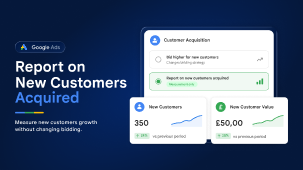
Google Ads is rolling out a new “Report on new customers acquired” option within its Customer Acquisition settings, giving advertisers a cleaner way to measure new customer acquisition performance without changing how campaigns bid.
For ecommerce advertisers, this is a useful development.
Until now, advertisers wanting detailed visibility into new versus existing customers often had to enable a New Customer Acquisition bidding option, even if they weren't actually looking to change their bidding strategy.
Google is now separating those two objectives:
Measurement: How many new customers are we acquiring?
Optimisation: Do we want Google to actively bid differently for new customers?
That distinction could make Google Ads new customer reporting much easier to use.
In short: The new “Report on new customers acquired” setting allows advertisers to measure new customers and new customer value while keeping their existing bidding strategy unchanged.
Google Ads is also continuing to evolve its approach to automation and transparency. For another recent development, read our guide to Google Ads AI content labels.
What's Changing in Google Ads Customer Acquisition Reporting?
Within Google Ads' Customer Acquisition settings, advertisers are beginning to see a new option:
Report on new customers acquired
Selecting it allows advertisers to measure purchases from new and existing customers without changing existing bidding behaviour.
It also unlocks reporting including:
-
New customers
-
New customer value
This means advertisers can evaluate new customer acquisition performance without instructing Smart Bidding to prioritise new customers.
How Is “Report on New Customers Acquired” Different From the Existing New Customer Acquisition Goal?
Google's New Customer Acquisition capabilities already allow advertisers to optimise towards acquiring new customers.
For example, advertisers can tell Google that new customers are worth more, encouraging Smart Bidding to place additional value on acquiring them.
That's useful when customer acquisition is part of the bidding strategy.
But sometimes advertisers simply want the data.
They may want to understand:
How many customers did Google Ads actually bring into the business for the first time?
without telling Google to change how it bids.
The new reporting-only option provides that separation.
Before
Want new-customer reporting? → Enable NCA bidding configuration → Potentially influence optimisation
Now
Want new-customer reporting? → Enable reporting → Keep existing bidding unchanged
That's the real benefit of this Google Ads update.
It Also Removes an Advertiser Workaround
Some advertisers previously used a workaround to access this reporting.
They would enable “Bid higher for new customers” but assign a very small incremental new-customer value, often 0.01, so the bidding impact was negligible while still unlocking the reporting.
The new reporting-only setting removes the need for that workaround.
It's a small platform change, but a sensible one.
Why Does New Customer Reporting Matter?
Most ecommerce reporting naturally focuses on metrics such as:
Revenue | ROAS | CPA | Conversion Rate
But those metrics don't necessarily tell you whether advertising is growing the customer base.
Consider two campaigns:
|
Campaign A |
Campaign B |
|
|
Spend |
£10,000 |
£10,000 |
|
Revenue |
£50,000 |
£50,000 |
|
ROAS |
5 |
5 |
|
New Customers |
100 |
350 |
At first glance, the campaigns appear identical.
Both generated £50,000 from £10,000 spend.
But from a customer-growth perspective, they're doing very different jobs.
Campaign B brought significantly more first-time customers into the business.
That becomes particularly important for brands where repeat purchase rate and customer lifetime value (LTV) are significant.
ROAS Doesn't Always Tell the Whole Story
A strong ROAS can sometimes be driven heavily by existing customers who already know and trust the brand.
That's not necessarily bad. Existing customers are valuable.
But it raises an important strategic question:
Are our campaigns harvesting existing demand, or creating new customers?
With clearer Google Ads new customer reporting, advertisers can start looking beyond overall ROAS and ask:
-
What percentage of customers acquired through Google Ads are new?
-
Which campaigns generate the most first-time buyers?
-
What is our cost of acquiring a new customer?
-
How much revenue or value is coming from newly acquired customers?
-
Are campaigns with similar ROAS contributing differently to business growth?
Google has also expanded lifecycle reporting capabilities around metrics such as new customers and customer acquisition cost, making customer-level measurement increasingly important within Google Ads.
How Does Google Ads Know Whether Someone Is a New Customer?
This is where implementation becomes important.
Google can use different signals to distinguish new customers from existing customers, including first-party customer information and purchase-conversion data.
Google recommends using strong first-party data through Customer Match lists, alongside new-customer acquisition reporting through the Google tag, to improve the accuracy and coverage of customer classification.
Advertisers can also pass a new customer parameter with purchase conversions, indicating whether the purchaser is new or existing.
Google's customer acquisition reporting works with Purchase conversions and supports implementations including Google Ads conversion tracking, Google Tag Manager, Shopify, Firebase, Google Analytics and offline conversion imports.
The Important Limitation: Data Quality Matters
Turning on the reporting option doesn't automatically guarantee perfect new-customer data.
The quality of the insight depends heavily on the quality of the signals Google receives. Advertisers should therefore ensure:
-
Customer lists are accurate and regularly updated
-
Customer Match is implemented where appropriate
-
Purchase conversion tracking is reliable
-
New versus existing customer information is passed correctly
-
Google Ads data is validated against CRM or ecommerce backend data
Google specifically recommends providing new-customer information through the tag because this supplies stronger ground-truth data and can improve its new-customer detection.
Should Advertisers Change Their Google Ads Bidding Strategy?
Not necessarily, and that's exactly the advantage of this update.
You can start by using the feature for measurement only.
For example:
Step 1: Enable new-customer reporting.
Step 2: Establish a baseline.
Step 3: Understand which campaigns are acquiring new customers.
Step 4: Compare new-customer acquisition with ROAS, CPA and profitability.
Step 5: Decide whether actively optimising towards new customers makes commercial sense.
This allows the data to inform the strategy, rather than changing the strategy simply to access the data.
For advertisers reviewing Performance Max campaign controls more broadly, our breakdown of the Google Ads budget panel for Performance Max explains another recent change designed to provide greater visibility into campaign performance and budget decisions.
What Should Ecommerce Advertisers Do?
For retailers where customer acquisition and repeat purchases matter, we'd recommend exploring the new reporting option as it becomes available.
In particular:
Enable the reporting where appropriate without changing bidding.
Add New Customers and New Customer Value to relevant campaign reporting.
Review first-party customer data and ensure customer lists remain accurate.
Validate the numbers against CRM or ecommerce backend information where possible.
And most importantly, start evaluating campaigns through both:
Advertising Performance + Customer Growth
Key Takeaways
|
Topic |
What You Need to Know |
|
New option |
Report on new customers acquired |
|
Purpose |
New-customer measurement without changing bidding |
|
New reporting |
New Customers & New Customer Value |
|
Smart Bidding impact |
None when using reporting-only mode |
|
Previous workaround |
No longer necessary |
|
Data requirement |
Accurate purchase and customer signals remain important |
|
Best use |
Understand acquisition before deciding whether to optimise towards it |
ShoppingIQ Recommendation
We see this as a useful reporting improvement rather than a major change to Smart Bidding.
The real opportunity is the ability to separate:
Measure First → Understand → Then Decide Whether to Optimise
Advertisers shouldn't automatically switch campaigns to aggressive new-customer acquisition bidding simply because the reporting becomes available.
Instead, use the additional visibility to understand how Google Ads is contributing to actual customer growth.
For ecommerce businesses, that's an important distinction.
A campaign delivering an excellent ROAS from predominantly existing customers may be commercially valuable.
A campaign delivering the same ROAS while bringing hundreds of new customers into the business may be creating an entirely different type of long-term value.
Final Thoughts
The most valuable part of this update isn't another reporting column.
It's the separation of measurement from optimisation.
Google Ads can now give advertisers greater visibility into new-customer acquisition without requiring them to change the way their campaigns bid.
And that allows businesses to ask a better question.
Not simply:
“What ROAS did our Google Ads generate?”
But:
“How much did our Google Ads actually grow the business?”
For ecommerce advertisers focused on sustainable growth, that's a metric worth understanding.
Want to improve the performance, targeting and efficiency of your ecommerce campaigns? Explore ShoppingIQ's Google Shopping Ads management service and discover how smarter feed and campaign optimisation can help drive more profitable growth.
Frequently Asked Questions
What is “Report on new customers acquired” in Google Ads?
“Report on new customers acquired” is a Customer Acquisition reporting option that allows advertisers to measure new customers and new customer value without changing how their campaigns bid.
Does the new customer reporting option change Smart Bidding?
No. The reporting-only option is designed to provide new customer acquisition data without applying additional value or bidding adjustments for new customers.
What metrics does Google Ads provide for new customer acquisition?
Advertisers can use metrics including New Customers and New Customer Value to better understand how campaigns contribute to customer acquisition and business growth.
How can advertisers improve the accuracy of new customer reporting?
Accurate first-party customer data, Customer Match lists, reliable purchase conversion tracking and properly implemented new versus existing customer signals can improve the quality of Google Ads new customer reporting.








No comments yet.