


Google Is Changing Language Targeting for Search & Performance Max: What Advertisers Need to Know
Google is changing how language targeting works across Search and Performance Max campaigns from September 2026, giving Google more control over audience matching through automation and contextual signals. This update is important for advertisers managing campaigns across multiple countries, languages, and regions. Retailers should review their campaign settings, ad copy, landing pages, search terms, and conversion performance before Q4. With Black Friday and Christmas approaching, understanding these changes early can help maintain campaign efficiency and traffic quality. This guide explains what is changing, how it impacts Performance Max, and what advertisers should do to prepare.
04 Sep, 2026
Google is making an important change to how language targeting works across Google Search and Performance Max campaigns from September 2026.
For advertisers managing Google Ads campaigns across multiple countries, regions, and languages, this update is worth reviewing ahead of Q4, especially with Black Friday and Christmas approaching.
As Google continues moving towards more automated campaign optimisation, understanding how targeting signals work will become increasingly important for maintaining campaign performance.
What is changing?
Google is removing the campaign-level language targeting setting from Search campaigns.
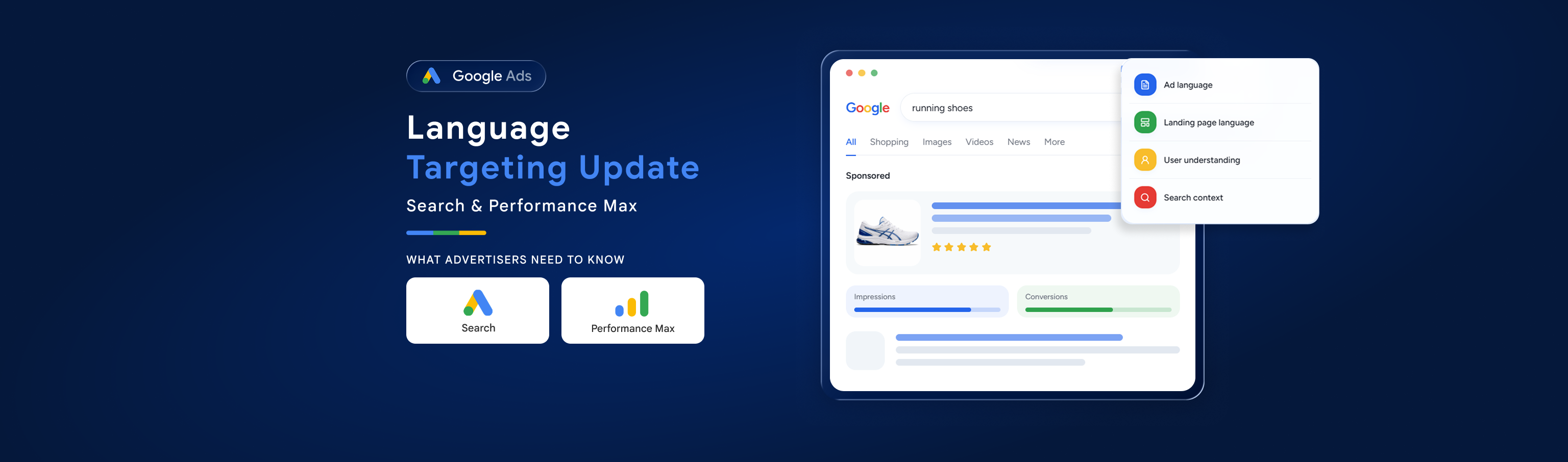
Instead of advertisers manually selecting which languages a Search campaign should target, Google will increasingly determine eligibility based on multiple contextual signals, including:
-
The language used in the ad
-
The language of the landing page
-
Google's understanding of the languages a user understands
-
The context surrounding the user's search
This means language targeting for Google Search campaigns is becoming more automated, with Google relying more heavily on its own machine learning systems to determine relevant users.
What about Performance Max?
Performance Max is also affected, but there is an important distinction.
The existing campaign language setting will no longer control the Search Network portion of Performance Max campaigns.
Language settings will, however, continue to apply to other Performance Max inventory, including:
-
YouTube
-
Display
-
Discover
-
Gmail
Importantly for retailers, Shopping ads within Performance Max are not affected by language settings in the same way, as product relevance continues to rely heavily on signals from product data and feeds.
For advertisers looking to improve Performance Max efficiency, understanding campaign signals and product data quality remains essential. You can also review our insights on Google Ads Budget Panel for Performance Max campaigns to understand how better budget visibility can support campaign optimisation.
Why does this matter?
Historically, language targeting has been another campaign-level control advertisers could use when structuring campaigns across countries and languages.
With Google taking greater control over language matching, advertisers should not simply assume that traffic will continue behaving exactly as it did before the change.
This is particularly important for businesses operating across multiple markets.
For example, an advertiser may have separate English and local-language campaigns within the same country. If campaign-level language targeting is no longer acting as the same boundary between those campaigns, Google may have greater flexibility in deciding which users and searches are relevant.
That does not necessarily mean performance will decline.
However, it does mean monitoring campaign performance, search behaviour, and customer acquisition signals becomes more important.
Advertisers can also use Google Ads reporting insights such as tracking new customers acquired from Google Ads campaigns to understand how these changes impact customer growth.
What should advertisers check?
Ahead of the change, advertisers should review the following areas:
1. Existing language targeting
Identify Search campaigns currently using specific language settings, particularly accounts operating across multiple languages or regions.
Understanding which campaigns rely heavily on language targeting will help advertisers prioritise monitoring after the rollout.
2. Ad copy
Make sure the language used within ads clearly reflects the audience and market the campaign is intended to reach.
Strong ad relevance signals will become increasingly important as Google uses more automation to determine user intent.
3. Landing pages
Check that users are being directed to an appropriate language version of the website.
The relationship between the search → ad → landing page becomes increasingly important as Google uses more contextual signals to understand language relevance.
4. Search terms
Once the change begins rolling out, monitor Search Terms closely.
Look for:
-
Unexpected queries
-
Different languages appearing in traffic
-
Changes in user intent
-
New search patterns that were not previously visible
5. Geographic performance
Language and geography should not be considered interchangeable.
Continue reviewing location targeting and geographic performance independently, particularly for international campaigns.
6. Conversion performance
Monitor key metrics including:
-
Conversion rate
-
CPA
-
ROAS
-
New customer acquisition
A significant shift in traffic quality may indicate that Google is matching campaigns to a broader set of users than previously.
What should retailers using Performance Max do?
Retail advertisers should avoid assuming that the entire Performance Max campaign is changing in exactly the same way.
The change primarily affects how language settings apply to the Search component of Performance Max.
Other PMax inventory continues to use campaign language settings, while Shopping inventory has its own product and feed-based relevance signals.
For retailers, this makes it important to review Search performance alongside overall Performance Max performance rather than relying only on campaign-level results.
A strong product feed remains one of the most important foundations for successful Google Shopping campaigns.
If you want to improve product visibility, optimise product data, and maximise Shopping campaign performance, explore our Google Shopping Ads solutions.
Ready to improve your Google Shopping performance? Get in touch with ShoppingIQ and discover how smarter feed management can help your products reach more customers.
Why this matters ahead of Black Friday and Christmas
The timing makes this particularly relevant.
We are entering the most important trading period of the year for many ecommerce businesses, with Black Friday, Cyber Monday and Christmas approaching.
This is not the ideal time to discover that campaign traffic patterns have changed without anyone noticing.
Before peak season, advertisers should understand:
What changed → which campaigns are affected → what normal performance looks like → what needs monitoring after rollout.
At ShoppingIQ, we recommend adding language targeting to your Q4 campaign readiness checks now, rather than waiting for a performance change to highlight the issue.
As Google Ads continues moving towards greater automation, strong campaign management increasingly means understanding where advertiser controls are changing — and ensuring the signals surrounding that automation are as strong as possible.
Frequently Asked Questions
What is changing with Google Ads language targeting in 2026?
Google is removing campaign-level language targeting controls from Search campaigns and using more automated signals such as ad language, landing page language, user preferences, and search context to determine relevant audiences.
Does this change affect Performance Max campaigns?
Yes, but only partially. The change mainly affects the Search Network portion of Performance Max. Other inventory such as YouTube, Display, Discover, and Gmail will continue using campaign language settings.
Are Google Shopping ads affected by the language targeting update?
Shopping ads within Performance Max are not affected in the same way because product relevance depends heavily on product data, feed quality, and other shopping signals.
How can advertisers prepare for Google’s language targeting changes?
Advertisers should review campaign language settings, check ad copy and landing page relevance, monitor search terms, analyse geographic performance, and track conversion metrics after the rollout.
Will Google Ads automation reduce advertiser control?
Google Ads is increasingly using machine learning and automation to improve targeting decisions. While some manual controls are changing, advertisers can still influence performance through strong creative, accurate product data, audience signals, and conversion tracking.
What should ecommerce retailers do before Q4?
Retailers should review their Google Ads campaigns before Black Friday and Christmas, monitor changes in traffic quality, and ensure their product feeds and campaign signals are fully optimised.