


AI Max for Shopping – Beta: One Product, Multiple Titles: How Google AI Is Changing Shopping Feed Optimisation
Google's AI Max for Shopping beta is changing how product titles can work in Shopping campaigns. Instead of relying solely on one static product title, Google AI can dynamically create query-matched product titles based on a shopper's search and intent.
18 Sep, 2026
For years, product title optimisation in Google Shopping has largely revolved around one question:
What is the best possible title for this product?
Retailers and agencies have spent significant time deciding which attributes should appear first, which keywords matter most, how much detail to include and how titles should differ across product categories.
That approach is beginning to evolve.
Google is increasingly moving towards a world where one product can have different versions of its title depending on where the product appears and what the shopper is looking for.
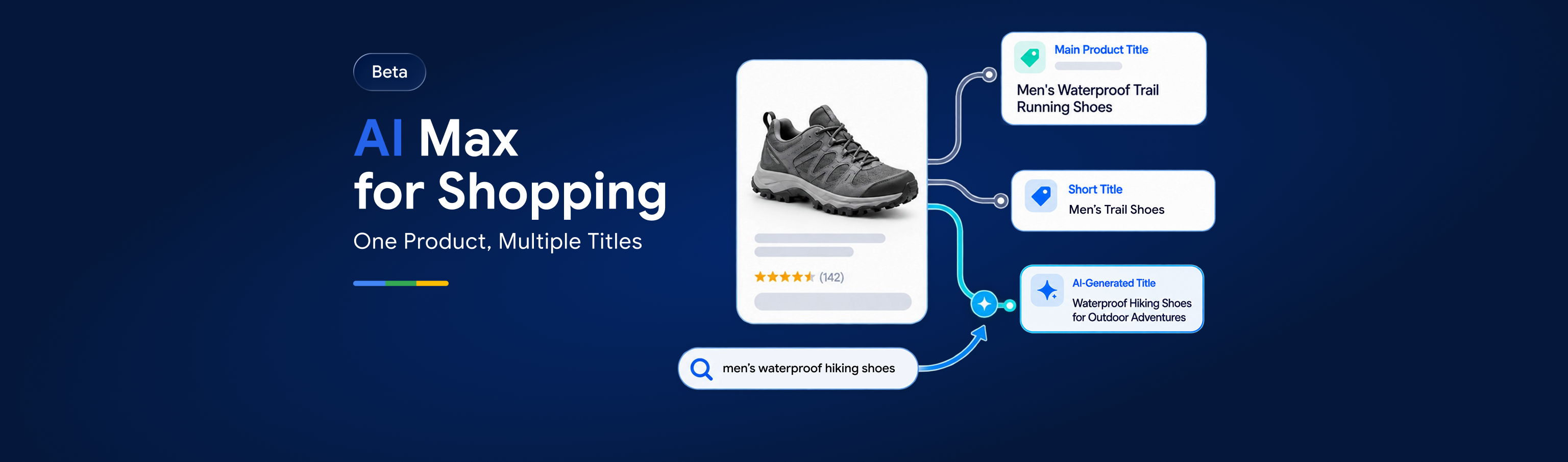
We can now see three distinct title layers emerging:
Main Product Title → Detail + Search Relevance
Short Title → Clarity + Visual Discovery
Google AI-Generated Title → Dynamic Query + Intent Relevance
And with Google's new AI Max for Shopping beta and Product Titles reporting, this evolution is becoming much more visible to advertisers.
1. The Main Google Shopping Product Title Still Matters
The standard Merchant Center [title] attribute remains fundamental to Shopping advertising.
It describes the product and helps Google understand what is being sold. For many retailers, title optimisation therefore focuses on combining the most useful attributes - such as brand, product type, model, colour, size or other relevant features - in an order that makes sense for the category.
Nothing about Google's recent developments means retailers should stop optimising their primary product titles.
In fact, good underlying product data may become even more important as Google AI increasingly uses Merchant Center data, website content and other signals to understand products and create more relevant ad experiences. Google's existing Merchant Center guidance confirms that it may use information from landing pages, images and other signals to enrich product titles to better match a shopper's search.
This makes effective Google Shopping ads feed management and optimisation increasingly important as product data becomes the source material used by both traditional Shopping systems and newer AI-powered experiences.
The feed is therefore becoming more than something Google simply displays.
It is increasingly becoming source material for Google's AI.
2. Google Merchant Center Short Title: A Different Title for a Different Environment
Another piece of this evolution is the Merchant Center [short_title] attribute.
Unlike the main title, Short Title is deliberately designed to be concise.
Google says it can be used in Demand Gen and visual Performance Max formats such as YouTube and Discover, without affecting titles on Search or Product Listing Ads. Google recommends 5–65 characters and suggests aiming for fewer than 40 characters where possible.
For a more detailed breakdown of the attribute and its use across visual placements, see our guide to the Google Short Title attribute for Performance Max visual placements.
This distinction matters because someone actively searching for a product and someone discovering it while browsing YouTube or Discover are not necessarily in the same mindset.
Consider:
Main Title:
Nike Air Max 270 Men's Running Shoes Black/White Size 10
Short Title:
Nike Air Max 270
The first provides more product detail and search relevance.
The second allows someone scrolling quickly through a visual environment to understand the product almost immediately.
The important lesson is that Short Title shouldn't simply be an existing title cut off after a certain number of characters.
It should be treated as a separate optimisation field with a different purpose.
3. How AI Max for Shopping Creates AI-Generated Product Titles
This is where things become considerably more interesting.
AI Max for Shopping is a beta suite of targeting and creative enhancements for Shopping campaigns that uses Google AI to improve relevance across increasingly complex and conversational searches.
Its text customisation feature can dynamically update product titles according to a shopper's search query and intent.
Google uses information from the Merchant Center feed alongside generative AI and extractive techniques to create query-matched titles. According to Google, a customised title is intended to serve when its system predicts that it will perform better than the advertiser's original title; otherwise, the original title can continue to serve.
Google provides an example where a relatively generic title such as:
Men's Shoe SKU 123
could be presented more meaningfully as:
Men's Waterproof Hiking Boot
if the available product information supports it.
This represents an important shift.
Historically, advertisers optimised a product title to cover as many valuable searches as reasonably possible.
Google is now moving towards:
Product Data → Shopper Query/Intent → AI-Selected Product Information → Customised Title
Rather than one title trying to answer every possible search, Google can potentially adapt the product message to the particular search taking place.
4. Google Product Titles Reporting Shows AI-Generated Titles
Automation becomes much more useful when advertisers can understand what the system is doing.
Google's new Product Titles report provides a sample of product titles created by Google AI that actually appeared in ads.
The report can show information including the customised title, original product title, Item ID and performance metrics.
This gives advertisers an opportunity to ask questions such as:
-
Is Google emphasising attributes that we have underused in our original titles?
-
Which AI-generated variations are receiving stronger engagement?
-
Is Google interpreting the product correctly?
-
Are there recurring words or product benefits appearing across successful variations?
-
Are there examples where the AI-generated wording is inaccurate, misleading or inconsistent with the brand?
Importantly, advertisers may see multiple customised titles associated with the same product.
That reinforces the underlying direction: we are no longer necessarily dealing with one product and one advertising title.
We are moving towards dynamic product messaging.
5. AI Max for Shopping Is Bigger Than Product Titles
AI Max for Shopping is not simply a product-title rewriting tool.
Google describes it as a suite of targeting and creative enhancements for Shopping campaigns, including text customisation and Final URL expansion.
Final URL expansion can move beyond the individual product URLs supplied through Merchant Center and identify other commercially relevant pages on the retailer's website, such as category pages, new-arrival pages or editorial content.
This can allow campaigns to participate in more research-oriented or mid-funnel searches using hybrid text and product formats. Final URL expansion requires text customisation to be enabled and is currently available with Target ROAS bidding.
Google is therefore working on several parts of the traditional Shopping experience simultaneously:
Query → Product → Title → Ad Message → Landing Page
And AI can increasingly influence each step.
Google says AI Max for Shopping is also designed for newer search environments including AI Overviews and AI Mode, making this particularly relevant as shopping discovery becomes more conversational.
6. More Google AI Automation - But Also More Advertiser Controls
Giving Google greater freedom over product messaging naturally creates concerns around accuracy, branding and compliance.
Google has therefore included several advertiser controls within AI Max for Shopping.
These include term exclusions, messaging restrictions, brand exclusions, URL exclusions and text guidelines. Advertisers can exclude up to 25 specific terms or phrases from generated assets and define up to 40 messaging restrictions covering concepts, associations, styles or tone.
As Google's advertising ecosystem introduces more AI-generated content, retailers should also understand wider transparency developments such as Google Ads AI content labels, particularly when AI is also being used to generate or edit product imagery and creative assets.
Reporting is also expanding beyond product titles.
AI Max for Shopping reporting includes the Product Titles report alongside Search Terms, Landing Pages and Expanded Final URL Assets reporting, helping advertisers understand where Google's automation is creating additional reach or changing the customer experience.
Google currently recommends allowing at least two weeks after enabling AI Max for Shopping before making optimisation changes such as adding text guidelines, so advertisers have sufficient reporting data to evaluate.
7. Does AI Max for Shopping Make Feed Optimisation Less Important?
We believe the opposite may be true.
If AI increasingly uses the feed as a product knowledge source, the quality of the information feeding the AI becomes critical.
Poor product data gives automation less reliable information to work with.
Rich, accurate product data gives Google's systems more context from which to identify relevant attributes and match products to increasingly complex searches.
Feed optimisation therefore starts evolving from:
“What exact title should we show?”
towards:
“Have we given Google enough accurate product information to understand when, why and for whom this product is relevant?”
That is a significantly broader optimisation challenge.
8. What Should Retailers Do About AI Max for Shopping Now?
There is no reason to enable every new AI capability across every campaign-or start rewriting entire feeds-simply because Google is generating customised titles.
A more measured approach is:
Review → Understand → Identify Patterns → Test → Optimise
Start by checking whether the Product Titles report is available and reviewing Google's customised titles against the originals.
Look for both good and bad examples.
A strong AI-generated title may reveal a product benefit, use case or attribute that deserves greater prominence in the feed.
A poor title may reveal incomplete source data, ambiguous website content or an area where stronger controls are required.
At the same time, retailers should continue treating the three title types differently:
Main Title → Detail + Search Relevance
Short Title → Clarity + Visual Discovery
Google AI Title → Dynamic Query + Intent Relevance
Each serves a different purpose.
9. Can Advertisers Switch AI-Generated Product Titles Off?
Greater automation will not be appropriate for every advertiser.
Some retailers may have tightly controlled brand terminology, compliance requirements or carefully structured product titles. Others may simply prefer to gather more data before allowing Google greater flexibility over how products are described.
The level of control depends on the campaign type.
For AI Max for Shopping, advertisers can choose whether to activate AI Max features, including Text Customisation. This means retailers do not need to adopt the feature across every Shopping campaign immediately and can take a more selective testing approach.
Performance Max campaigns using a Merchant Center feed require an important distinction.
Google's current guidance states that Shopping ads may still serve optimised product titles based on a user's query even when Text Customisation is switched off. Therefore, disabling Text Customisation should not be treated as a complete opt-out from Google's Merchant Center product-title optimisations.
For advertisers that specifically want to opt out of these Merchant Center feed optimisations, Google advises contacting their Google account representative or Google Ads support. Google states that opt-out requests are generally processed within 3–5 business days.
This gives retailers several possible approaches:
Monitor Only → Controlled Testing → Wider Adoption
A retailer could initially review Google's Product Titles reporting without making immediate changes, test newer AI capabilities on selected campaigns or product categories, and expand adoption only when the results justify it.
For brands where product wording is particularly sensitive, an opt-out may be more appropriate until the business is comfortable with the level of automation.
At ShoppingIQ, we would recommend making this decision account by account rather than applying the same approach across an entire client portfolio.
Factors such as brand requirements, product complexity, historical performance, compliance considerations and the quality of the underlying product data should all influence whether greater title automation is appropriate.
The objective shouldn't be:
“AI is available, so switch it on.”
It should be:
“Where can AI add value without compromising accuracy, control or performance?”
Frequently Asked Questions About AI Max for Shopping
What is AI Max for Shopping?
AI Max for Shopping is a beta suite of Google Ads features that uses Google AI to improve the relevance and reach of Shopping campaigns. It includes capabilities such as text customisation, dynamically optimised product titles, Final URL expansion and additional reporting and advertiser controls.
Can Google AI automatically rewrite Google Shopping product titles?
Yes. Google can create customised product titles using information from a retailer's Merchant Center feed, website and other relevant signals. The AI-generated title can be matched to the shopper's query and intent and is designed to serve when Google predicts it will perform better than the original title.
What is the difference between a product title, Short Title and AI-generated title?
The main product title is the standard Merchant Center title used for detailed product information and search relevance. The Short Title is a concise version intended for Demand Gen and visual Performance Max environments such as YouTube and Discover. An AI-generated product title is dynamically created or adapted by Google to better match a specific shopper's query and intent.
Does AI Max for Shopping mean product feed optimisation is no longer necessary?
No. Feed optimisation may become even more important because Google's AI relies on accurate product information to understand what a retailer sells. Strong titles, attributes, product descriptions, landing-page content and structured Merchant Center data give Google's systems better information from which to generate relevant advertising experiences.
Can advertisers turn off Google's AI-generated Shopping titles?
Advertisers can control Text Customisation within AI Max for Shopping, but Performance Max campaigns connected to Merchant Center may still serve optimised Shopping titles even when Text Customisation is turned off. Advertisers wanting to opt out of Google's Product Data Customisation for Shopping ad titles can contact their Google account representative or Google support.
How long does it take to opt out of Google Product Data Customisation?
Google states that requests to opt out of Product Data Customisation for Shopping ad titles are typically processed within 3–5 business days.
How long should advertisers wait before evaluating AI Max for Shopping performance?
Google recommends waiting at least two weeks after enabling AI Max for Shopping before making optimisation changes such as adding text guidelines. This gives advertisers more reporting data with which to evaluate performance and AI-generated outputs.
Is AI Max for Shopping available for every product feed language?
Not currently. Google's current documentation states that AI Max for Shopping text customisation is limited to English feeds. Advertisers should check Google's latest eligibility guidance before planning a wider rollout across international feeds.