



The Rise and Fall in Retail eCommerce: Analysing January 2026
January 2026 saw a sharp post-peak reset in retail eCommerce. Explore month-on-month winners and losers, key category shifts, and what retailers should prioritise next.
12 Feb, 2026
Introduction
January is almost always a month of correction for retail eCommerce. Following the intensity of Black Friday, Christmas, and New Year trading, consumer demand typically cools as shoppers readjust budgets, reduce discretionary spend, and move away from gifting-led behaviour.
January 2026 clearly reflected this seasonal slowdown. The Total Market declined sharply by 33.0% month-on-month, with most categories experiencing significant pullback after December’s peak. However, even in a broadly negative month, performance varied meaningfully across sectors. Some categories showed relative resilience or even growth, while others saw steep declines as demand normalised.
Below, we analyse the top-performing sectors and under-performing sectors based purely on month-on-month (MoM) performance, followed by broader takeaways for retailers entering Q1.
Top-Performing Sectors (MoM)
1. Gardening (+26.6%)
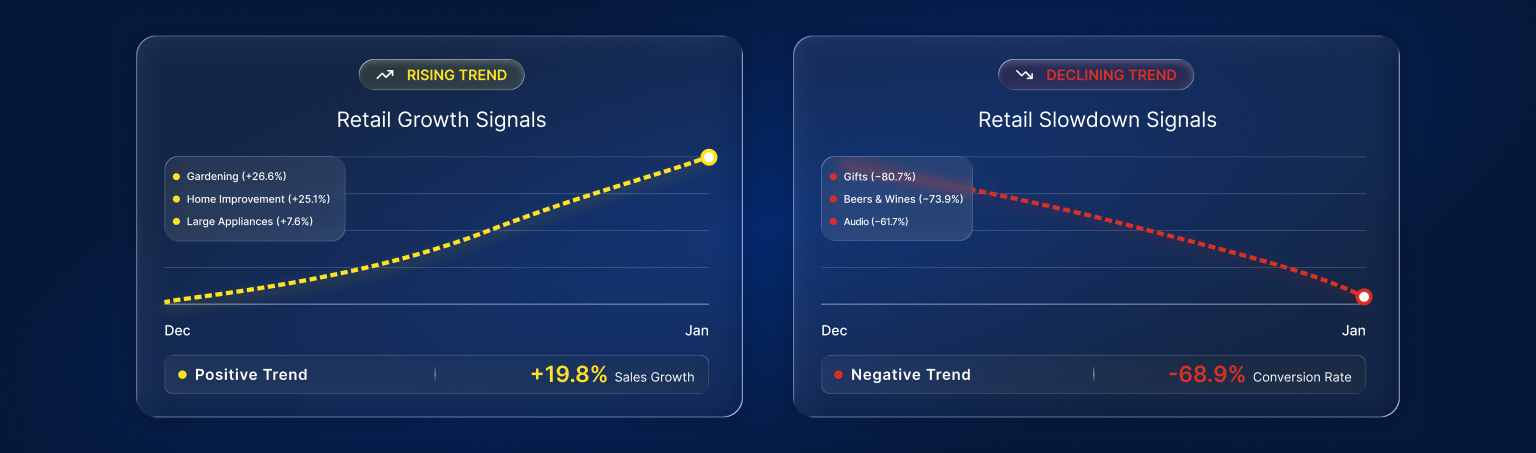
Gardening emerged as the strongest month-on-month performer in January, growing by +26.6%. While winter is traditionally a quieter period for outdoor categories, this uplift suggests early planning behaviour from consumers preparing for spring.
The growth was likely driven by purchases of seeds, tools, and early maintenance products rather than large-scale outdoor projects. This indicates that a segment of consumers is becoming more proactive, spreading spend earlier in the year rather than waiting for peak spring months.
2. Home Improvement (+25.1%)
Home Improvement also delivered a standout performance, rising +25.1% MoM, making it one of the few categories to record substantial growth.
With consumers spending more time indoors during winter, January often becomes the month for small home projects. This includes storage solutions, minor repairs, redecorating, and energy-efficiency upgrades. Unlike more discretionary categories, Home Improvement benefits from practical need-based demand, which helps insulate it from post-holiday spending fatigue.
3. Large Appliances (+7.6%)
Large Appliances recorded +7.6% MoM growth, outperforming most of the Electrical category, which declined sharply overall.
This growth was likely driven by replacement purchases rather than discretionary upgrades. January is a common month for consumers to address appliance failures or invest in efficiency improvements after year-end assessments of household costs. Retailers offering financing options and clear value messaging appear to have performed particularly well in this segment.
Under-Performing Sectors (MoM)
1. Gifts (−80.7%)
Gifts experienced the steepest decline of any category, falling −80.7% MoM. This drop is unsurprising given the category’s extreme reliance on December gifting occasions.
Once Christmas and New Year conclude, gifting demand collapses almost entirely, leaving January with minimal residual activity. The magnitude of the decline highlights how heavily this category is concentrated around peak seasonal events.
2. Beers & Wines (−73.9%)
Beers & Wines saw a dramatic −73.9% MoM decline, reflecting a combination of post-festive normalisation and behavioural shifts such as “Dry January.”
Heavy stock-up purchasing in December left little reason for consumers to return in January. This category continues to show one of the most pronounced peak-to-trough swings in the retail calendar.
3. Audio (−61.7%) and Gaming & Computing (−59.4%)
Within Electricals, Audio (−61.7%) and Gaming & Computing (−59.4%) were among the weakest performers.
These categories are highly gift-driven and promotion-dependent, benefiting massively during November and December before sharply correcting in January. Once consumers have upgraded devices or received tech as gifts, replacement cycles slow considerably, leading to abrupt post-peak declines.
Other Notable Month-on-Month Movements
-
Total Market: −33.0%
A broad-based contraction reflecting post-peak consumer retrenchment.
-
Clothing: −34.3%
Declines were widespread, particularly in Menswear (−51.1%), Accessories (−53.2%), and Childrenswear (−53.4%), as discretionary fashion spend softened.
-
Health & Beauty: −49.4%
Fragrance (−80.1%) dragged the category down, while everyday subcategories such as Haircare (−23.4%) and Skincare (−33.5%) showed relatively more stability.
-
Home & Garden (Overall): −0.6%
One of the most resilient areas of the market, supported by strength in Home Improvement and Gardening.
-
Sports & Outdoors: −39.3%
A moderate pullback after stronger late-Q4 demand, though less severe than gifting-led categories.
-
Mobile Commerce: −35.3%
Smartphone and tablet shopping slowed as consumers delayed upgrades post-holiday.
Looking Ahead: What Retailers Should Prioritise
For Stronger MoM Sectors
-
Home Improvement & Gardening
Retailers should lean into early-season planning, DIY messaging, and practical home upgrades. Educational content, project guides, and phased promotions can help sustain momentum into spring.
-
Large Appliances
Clear value propositions, energy-efficiency messaging, and flexible payment options will remain key drivers for replacement-led demand.
For Weaker MoM Sectors
-
Gifts & Beers/Wines
These categories should pivot quickly toward upcoming occasions such as Valentine’s Day and experiential gifting to reintroduce relevance.
-
Electricals & Tech
Shifting focus to accessories, warranties, and lower-ticket add-ons may help soften the post-peak drop until demand recovers later in the year.
-
Clothing
Transitional season ranges and value-led promotions will be critical to re-engagde cautious shoppers in Q1.
Conclusion
January 2026 delivered a clear post-peak reset for retail eCommerce, with most categories experiencing sharp month-on-month declines. However, the performance of Gardening, Home Improvement, and Large Appliances demonstrates that even in a down month, need-driven and forward planning categories can outperform.
For retailers, January is less about chasing growth and more about stabilisation, efficiency, and strategic repositioning. Those who align quickly to seasonal realities and consumer intent will be best placed to rebuild momentum as the year progresses.