



Google Tests Performance Max Channel Prioritisation: What Advertisers Need to Know
Performance Max has always been built around automation. Advertisers provide Google with their goals, budgets, creative assets, product data and audience signals, while Google's systems determine how campaigns serve across its inventory. Over time, however, Google has gradually started giving advertisers more visibility into what happens inside Google Performance Max. Channel Performance Reporting was an important step in that direction, giving advertisers greater insight into how campaigns perform across individual Google channels. Now, Google appears to be testing the next step: the ability to influence channel prioritisation within Performance Max.
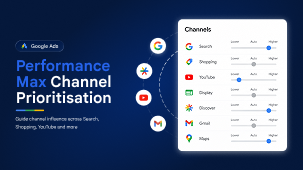
A new Performance Max Channel Prioritisation control has been spotted in selected Google Ads accounts as part of an alpha test.
While availability is currently extremely limited and Google has not announced a wider rollout, the test could represent an important change in how advertisers interact with Performance Max.
1. What is Performance Max Channel Prioritisation?
Performance Max campaigns can serve across Google's inventory, including:
-
Search
-
Shopping/product-based inventory
-
YouTube
-
Display
-
Discover
-
Gmail
-
Maps
Historically, advertisers have had limited direct control over how Performance Max distributes activity between these environments and Performance Max channels.
The new test reportedly introduces a Channels section within Performance Max campaign settings.
Advertisers participating in the alpha can influence individual channels towards:
Lower ← Auto → Higher
This introduces an important distinction.
Channel prioritisation is not channel budget allocation
A Higher setting does not mean an advertiser can tell Google:
“Allocate 30% of my Performance Max budget to YouTube.”
Similarly, selecting Lower doesn't simply switch a channel off.
Performance Max continues to control the campaign's overall channel mix.
Instead, reporting on the alpha indicates that these PMax channel controls influence how aggressively Google's bidding system can pursue conversions within individual channels.
In other words, advertisers may gain more influence over channel behaviour without taking full control away from Performance Max automation.
2. Why is Google testing this now?
The development makes more sense when viewed alongside Google's recent changes to Performance Max reporting.
For years, one of the biggest challenges with PMax was understanding where campaign activity was actually happening.
Google subsequently introduced Channel Performance Reporting, providing advertisers with more visibility across individual channels.
The evolution could therefore look something like this:
Automation → Greater visibility → Potentially greater advertiser influence
That is what makes this alpha particularly interesting.
Google isn't necessarily moving away from automation.
Instead, it may be experimenting with giving advertisers additional ways to guide the automation within Google Performance Max as part of a wider retail strategy.
More control creates another challenge
At first glance, Performance Max Channel Prioritisation sounds straightforward.
Imagine Channel Performance Reporting shows:
Search — strong ROAS
YouTube — lower ROAS
The natural reaction might be:
Search → Higher
YouTube → Lower
But that could oversimplify how Performance Max works.
Customers don't necessarily interact with one Google channel and immediately convert.
A shopper might:
See a product on YouTube
↓
Encounter the brand again through Display
↓
Search for the product later
↓
Convert through Search or Shopping
If we evaluate each channel only according to where the final conversion was attributed, we risk undervaluing channels that helped create or influence demand earlier in the journey.
That means channel-level visibility should not automatically become channel-level optimisation.
3. What should advertisers do now?
For most advertisers:
Nothing yet.
Channel Prioritisation remains an alpha test, and there is currently no indication that the controls are broadly available across Performance Max campaigns.
However, advertisers managing PMax should keep an eye on campaign settings for any new Channels or Performance Max Channel Prioritisation controls, alongside developments such as Performance Max negative keywords.
If the feature appears, we would recommend:
1. Don't immediately change the settings
Understand the existing campaign and channel behaviour first.
2. Review Channel Performance Reporting
Look at how activity is distributed across Google's inventory and different Performance Max channels before deciding whether intervention is necessary.
3. Consider the full customer journey
Don't judge a channel purely on isolated CPA or ROAS.
4. Establish a hypothesis before testing
There should be a clear reason for increasing or decreasing channel prioritisation—not simply because one channel appears stronger in a report.
5. Measure the impact
If the PMax channel controls are eventually tested, document the change and monitor how the wider campaign responds rather than looking only at the adjusted channel.
4. What could this mean for the future of Performance Max?
Perhaps the most interesting part of this test isn't the control itself.
It's what it could tell us about the direction Google Performance Max is heading.
Performance Max originally asked advertisers to place considerable trust in Google's automation.
Google has since introduced more reporting and transparency through features such as Channel Performance Reporting.
Channel prioritisation could represent another stage in that evolution:
Google controls the automation.
Advertisers understand more of what it is doing.
Advertisers may increasingly be able to guide it.
That could create a more useful middle ground between completely automated campaign management and the granular channel controls available through individual campaign types.
But more controls don't automatically produce better results.
If Performance Max Channel Prioritisation eventually rolls out more widely, the real skill won't simply be knowing where the setting is.
It will be understood when the data provides a strong enough reason to use it.
5. ShoppingIQ's view
Performance Max Channel Prioritisation is an interesting development, but it should currently be treated as an experiment rather than a new Performance Max best practice.
For now, advertisers should continue using Channel Performance Reporting to understand how PMax operates across Google's inventory and Performance Max channels while monitoring the rollout of additional controls and maintaining strong Google Shopping optimisation.
If Google expands the alpha or publishes further guidance, we'll continue to assess what the change means for ecommerce advertisers and how channel-level influence can be incorporated into Google Performance Max optimisation without losing sight of the wider customer journey.
Frequently Asked Questions About Performance Max Channel Prioritisation
What is Performance Max Channel Prioritisation?
Performance Max Channel Prioritisation is a new control being tested by Google that may allow advertisers to influence how strongly individual channels are prioritised within a Performance Max campaign. The feature does not give advertisers full control over budget allocation, but it may provide more influence over how Google’s automation behaves across different channels.
Can you control which channels Performance Max uses?
Performance Max can serve across Search, Shopping, YouTube, Display, Discover, Gmail and Maps. Advertisers have traditionally had limited control over how activity is distributed across these channels. Google’s Channel Prioritisation test may give advertisers more influence over individual channels, although Performance Max would still manage the overall channel mix.
Can you allocate a Performance Max budget by channel?
No. Performance Max Channel Prioritisation does not appear to allow advertisers to assign a specific percentage of budget to individual channels. Selecting a Higher or Lower priority is intended to influence how aggressively Google’s bidding system pursues conversions within that channel rather than directly controlling budget allocation.
How do I see which channels Performance Max is using?
Advertisers can use Channel Performance Reporting to understand how Performance Max activity is distributed across Google’s different channels. This reporting provides greater visibility into areas such as Search, YouTube, Display and other Google inventory, helping advertisers understand where campaign activity is taking place.
Should I lower YouTube if it has a lower ROAS in Performance Max?
Not necessarily. A lower reported ROAS does not always mean a channel is underperforming. YouTube and Display can influence customers earlier in the buying journey before they later convert through Search or Shopping. Advertisers should consider the wider customer journey before changing channel priorities based only on isolated CPA or ROAS.
Is Performance Max Channel Prioritisation available to all advertisers?
No. Performance Max Channel Prioritisation has been reported as an alpha test and is not currently available across all Google Ads accounts. Advertisers should monitor their Performance Max campaign settings for any new Channels or Channel Prioritisation controls and wait for further guidance from Google before treating it as a standard optimisation feature.










No comments yet.